


-
Products
-
About Us
-
Roasters
-
Gifts
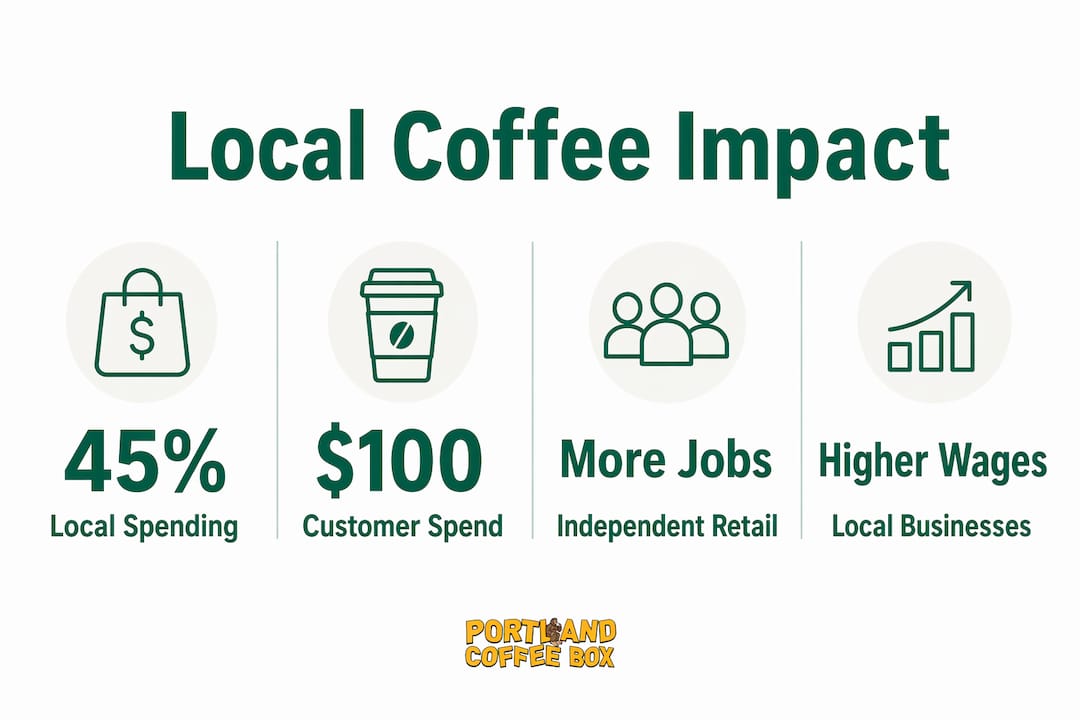
Every dollar you spend at a local coffee roaster does more than buy you a great bag of beans. Local coffee businesses keep more revenue circulating in their communities, create jobs with better local wage retention, and serve as gathering places that anchor entire neighborhoods. The local multiplier effect is real and measurable: a Midcoast Maine study found that $100 spent at a locally owned retailer generated $45 in additional local spending, compared to just $14 from a big-box purchase. The coffee industry is a large contributor to the U.S. economy and supports many jobs nationally — and independent roasters and cafes are where that impact runs deepest.
Want to act now? A specialty coffee subscription or gift box from Portland Coffee Box channels meaningful revenue directly to Portland’s small-batch roasters, shipped nationwide.
The economic case for buying local coffee comes down to where the money goes after you pay. When you buy from an independent roaster, the owner’s profit stays local, the barista’s wages get spent at nearby businesses, and the roaster’s supply purchases often go to local bakers, artists, and service providers. That chain of spending is the local multiplier in action.
Independent retailers in competitive markets deliver more employment and higher wages than large national chains, according to economic analysis at the county level. That wage advantage compounds over time because locally earned wages get spent locally too.
Pro Tip: When evaluating a coffee subscription or gift box, ask whether the brand names its roaster partners and describes how revenue reaches them. Roaster-directed payouts and storytelling are the clearest signals that your purchase genuinely supports local producers. Portland Coffee Box publishes roaster profiles so you can see exactly who you’re supporting.
The numbers behind the local-spending advantage are consistent across multiple independent studies.
| Study | Key Finding | Source |
|---|---|---|
| Midcoast Maine (ILSR) | $100 at a local retailer → $45 local spending vs. $14 at big-box | Institute for Local Self-Reliance |
| Dane County, WI (Civic Economics) | Independent restaurants return 60.7% of revenue locally vs. 30.4% for chains | Civic Economics / Dane Buy Local |
| U.S. Coffee Industry | — | Industry reporting |
| Local-Buy Employment Study | Independent retailers produce measurable employment and wage gains at the county level | University research |
A modest shift from chain to independent spending in Dane County would retain significantly more money in the local economy annually, according to Civic Economics.
One honest caveat: most multiplier studies focus on retail broadly, not coffee specifically, and geographic scope varies. The Midcoast and Dane County findings are among the most rigorous available, but local conditions always shape the actual outcome.
The economic role of a coffee shop extends well past the register. Sociologists call it the “third space” — a gathering place that is neither home nor work, where social mixing and community cohesion happen naturally. Michael Glass, director of the University of Pittsburgh’s urban studies program, notes that coffee shops excel at the social mixing that third spaces provide, in a way libraries and fire halls often cannot.

Research confirms that community-based coffee shops foster entrepreneurial ecosystems through stakeholder collaboration and co-value creation. In Avonmore, Pennsylvania, the arrival of a single coffee shop preceded a bakery, a yoga studio, and a card shop — each owner crediting the cafe for driving foot traffic to their doors.
Partnership types worth supporting or suggesting to your favorite local shop:
The role of small roasters in community life goes beyond coffee — they are often the first business to signal that a neighborhood is worth investing in.
Supporting local roasters does not require living near one. Here is a practical checklist for specialty coffee lovers and gift shoppers anywhere in the country.
Pro Tip: Before subscribing, check whether the service lists its roasters by name and updates its lineup seasonally. A rotating roster of named local roasters signals that the subscription is genuinely roaster-directed, not just a private-label product with local branding.
Shorter supply chains mean fewer miles traveled, less packaging, and lower emissions per bag. When a roaster ships directly to subscribers rather than routing through a national distribution center, the transport footprint shrinks considerably. Buying local also tends to support fresher product handling — beans roasted to order and shipped within days retain more of their character and require less protective packaging than shelf-stable commercial blends.
The benefits of local sourcing extend to public health as well. Reduced freight traffic means lower diesel emissions in urban corridors, contributing to better air quality in the communities where roasters and their customers live. Michigan State University’s Center for Community and Economic Development notes that buying local leads to higher local recirculation through wages, purchases, and charitable giving — and that the environmental co-benefits are a meaningful part of the full value of local purchasing.
Local coffee costs more. That is usually true, and pretending otherwise does not serve anyone. A 12-ounce bag from an independent roaster typically runs higher than a supermarket blend, and not every household budget accommodates that gap every month.
Scheduled subscriptions beat impulse purchases for both budget management and roaster revenue predictability. A monthly box locks in consistent income for the roaster, which is more valuable than sporadic large orders.
Portland Coffee Box is built around a straightforward premise: source the best small-batch beans from Portland’s top craft roasters, curate them for quality and seasonality, and deliver them to subscribers nationwide. Every box features beans from named local roasters who receive direct payments and gain marketing exposure to a national audience of specialty coffee enthusiasts.
The subscription lineup gives you options at every level of commitment:
Each subscription creates a predictable revenue stream for the roasters featured that month — something that matters enormously for small producers who cannot rely on walk-in traffic alone. Portland Coffee Box is also a 1% For the Planet member, donating a portion of revenue to environmental causes, which means your subscription supports both local roasters and broader sustainability commitments.
Local coffee businesses support the economy by recirculating revenue locally, creating jobs with stronger wage retention, and acting as community anchors that lift neighboring businesses.
| Point | Details |
|---|---|
| Local multiplier is measurable | $100 at a local retailer generates $45 in local spending vs. $14 at a big-box store (ILSR Midcoast study). |
| Independents return far more locally | Independent restaurants return 60.7% of revenue to the local economy vs. 30.4% for national chains (Civic Economics). |
| Coffee shops anchor communities | Third-space effects attract foot traffic, support neighboring businesses, and retain young professionals in smaller towns. |
| Subscriptions extend local impact nationwide | Curated boxes that name their roaster partners deliver predictable income and marketing exposure to small producers. |
| Portland Coffee Box | Subscriptions from the One Bag to the Four Bag and Micro Lot Box channel revenue directly to Portland’s local roasters, shipped nationwide with free shipping. |
The conventional framing around buying local coffee tends to stop at “it tastes better and supports small business.” Both are true, but they undersell what is actually happening. The economic research from Civic Economics and the Institute for Local Self-Reliance shows that the gap between local and chain recirculation rates is not marginal — it is roughly double or more across every category studied. That gap compounds. A community where independent businesses hold a meaningful share of the market generates more local tax revenue, more local employment, and more reinvestment in local organizations than one dominated by chains extracting revenue nightly.
What gets overlooked is the role of national subscription models in extending that effect beyond geography. A specialty coffee enthusiast in Chicago or Atlanta who subscribes to a Portland-roaster box is not just buying coffee — they are providing a small producer with the kind of predictable monthly revenue that makes it possible to hire a second employee, invest in better equipment, or take a risk on a new single-origin offering. Portland Coffee Box’s 1% For the Planet membership adds an environmental layer to that equation, connecting each purchase to causes that matter beyond the cup.
The trade-off conversation is worth having honestly. Local coffee costs more, and not every purchase decision can prioritize local impact. But for the purchases that can — especially gifts, subscriptions, and corporate orders — the evidence is clear that the local choice does more good, more durably, than the chain alternative.
Fresh, small-batch beans from Portland’s best craft roasters, delivered to your door anywhere in the country — that is the core of what Portland Coffee Box offers. Every subscription tier, from the entry-level One Bag Coffee Box to the enthusiast-grade Two Bag Micro Lot Box, channels direct payments to named local roasters and gives them national visibility. Free shipping on all orders, flexible monthly sizing, and corporate gifting options mean there is a format that fits whether you are treating yourself or buying for a team.
The Four Bag Coffee Box is a favorite for corporate gifts and larger households — four curated bags, four roasters supported, one easy monthly order. Gift shoppers can browse the full lineup at Portland Coffee Box and choose a one-time gift box or a recurring subscription. Every order is a direct vote for the local coffee economy.
The following studies and articles form the primary evidence base for this piece. Geographic scope and publication dates vary, so check the original source before applying findings to a specific local market.
Note: Most multiplier studies draw on retail broadly. Apply findings to your local coffee market with awareness of community size, business mix, and the study’s original geography.


