


-
Products
-
About Us
-
Roasters
-
Gifts
Every dollar you spend is a vote for the kind of supply chain you want to exist. The six highest-impact ways to support environmental causes with purchases are: buy certified products (ENERGY STAR, Fair Trade, FSC, Rainforest Alliance); choose durable, repairable, or secondhand goods over disposable ones; select companies that donate a verifiable percentage of revenue to environmental causes; prioritize local and small producers; subscribe to mission-aligned services that channel recurring revenue to vetted giving programs; and use your purchasing patterns to signal demand and shift supply chains. Portland Coffee Box, a 1% For the Planet member, is a concrete example of the subscription model done right.
Purchases do more than move money. They change what suppliers produce, how they source materials, and which product designs get funded for the next cycle. McKinsey research shows that procurement sits at the critical interface with upstream supply chains, and that real change often requires sourcing different materials and influencing product design rather than simply choosing the “best available” option on the shelf.
The same logic applies to individual shoppers. When you consistently buy certified coffee, FSC-certified paper, or ENERGY STAR appliances, you are sending a demand signal that manufacturers track. Enough of those signals, aggregated across thousands of buyers, shifts category economics. Suppliers who meet certified standards win more revenue; those who don’t face pressure to change or lose market share.
There are four concrete levers at work here. First, the demand signal itself tells producers which attributes to invest in. Second, the revenue you direct to mission-aligned companies funds their operations, their sourcing standards, and their giving programs. Third, purchasing durability over disposability reduces the total volume of goods manufactured. Fourth, choosing suppliers with transparent supply chains creates accountability pressure that travels upstream to farms, forests, and factories.
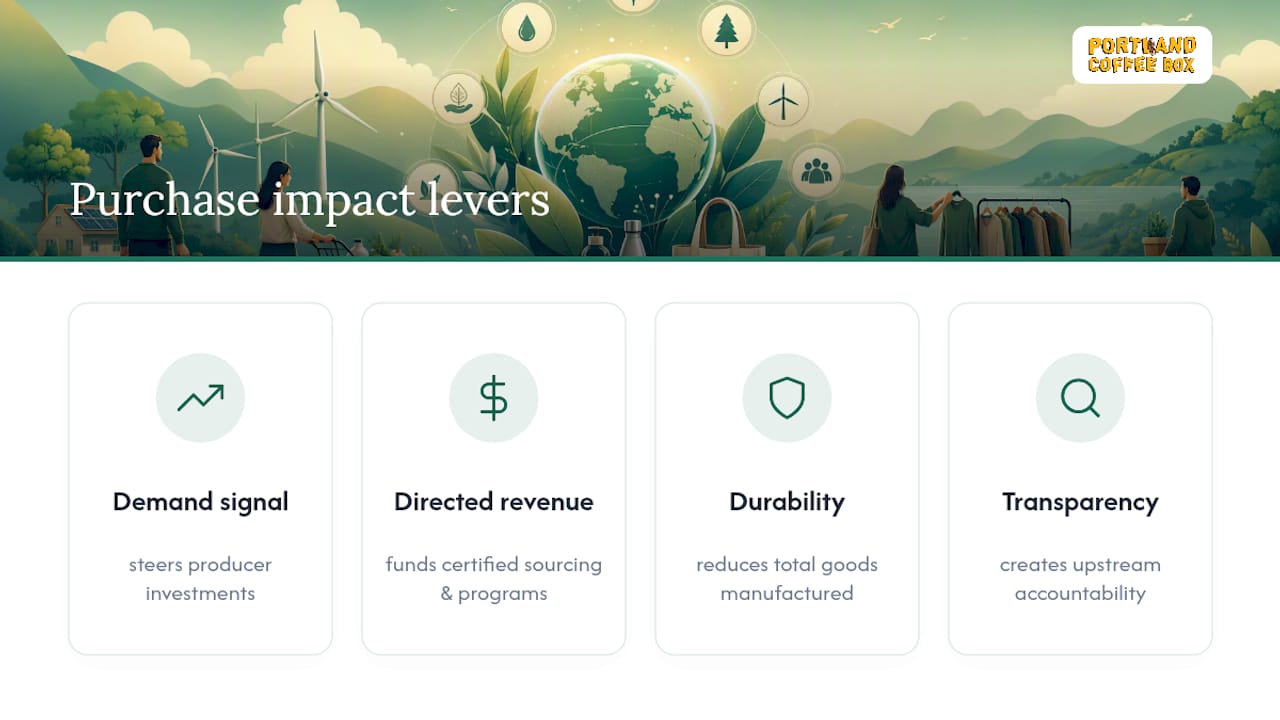
Pro Tip: Subscriptions amplify all four levers. A monthly coffee subscription, for example, creates a predictable revenue stream for small-batch roasters and their giving partners, rather than the irregular cash flow of one-off purchases. Predictable revenue is what lets a small producer plan a certified sourcing program or maintain a conservation partnership year-round.
Not every purchase carries equal environmental weight. Food, clothing, household energy and appliances, personal care and cleaning products, electronics, and recurring subscriptions are the categories where responsible buying tends to produce the largest measurable benefits.
Agriculture accounts for a significant share of global greenhouse gas emissions, land use, and water consumption. The best moves: buy Fair Trade or Rainforest Alliance certified coffee, cocoa, and tea; choose USDA Organic when pesticide reduction matters; and choose compostable bagasse food containers to reduce packaging waste when prioritizing local producers at farmers’ markets or through community-supported agriculture (CSA) boxes. For coffee specifically, buying from local roasters shortens the supply chain and keeps dollars in communities with strong accountability.
Fast fashion generates enormous textile waste and relies on supply chains with limited transparency. Buying secondhand, choosing durable natural-fiber garments, or selecting brands that publish supply-chain audits all reduce footprint. When buying new, look for GOTS (Global Organic Textile Standard) or Fair Trade Certified apparel.
ENERGY STAR-certified appliances use measurably less energy than standard models, and federal guidance specifically identifies ENERGY STAR and WaterSense as preferred purchasing programs. When replacing appliances, the certified option typically pays back its small premium through lower utility bills within a few years.
The EPA’s Safer Choice label certifies that every ingredient in a product meets safety and environmental standards. Choosing Safer Choice-labeled cleaners reduces aquatic toxicity and indoor air pollution.

Electronics carry heavy upstream extraction costs (rare earth mining, manufacturing emissions). Buy refurbished when possible, extend device life through repair, and recycle through certified e-waste programs rather than landfill.
Pro Tip: Avoid the “immediacy trap.” Choosing next-day or same-day shipping for a single item generates significantly more emissions per package than consolidated standard shipping. Batch your orders and choose the slowest shipping option that works for you.
The EPA’s Environmentally Preferable Purchasing program recommends preferring multi-attribute or life-cycle-based standards verified by competent third parties over single-attribute claims. That guidance is the right filter for shoppers too.
| Label | What it measures | What to expect as a buyer | Verification tip |
|---|---|---|---|
| ENERGY STAR | Energy efficiency for appliances, electronics, buildings | Certified products use less energy than federal minimums | Check the ENERGY STAR product database at energystar.gov |
| WaterSense | Water efficiency for fixtures and irrigation | Certified products use at least 20% less water | Look for the WaterSense label on the product or packaging |
| Safer Choice (EPA) | Chemical safety and environmental profile of cleaning/personal care ingredients | Every ingredient reviewed against EPA safety criteria | Search the Safer Choice product finder at epa.gov |
| Fair Trade Certified | Fair wages, trading terms, and community premiums for producers | Producers receive minimum price floors and community development funds | Verify at fairtradecertified.org |
| Rainforest Alliance | Sustainable agricultural and forestry practices | Farms meet specific environmental and social standards | Check the certification database at rainforest-alliance.org |
| FSC | Responsible forest management | Wood and paper products sourced from certified forests | Look for the FSC chain-of-custody number on packaging |
| USDA BioPreferred | Biobased content in products | Products contain a verified percentage of renewable biological ingredients | Search the BioPreferred catalog at biopreferred.usda.gov |
The Green Procurement Compilation (GPC), maintained as the federal reference for sustainable purchasing, is a useful public resource for verifying which standards carry real third-party oversight. Platforms like Amazon Business surface many of these labels through product filters, making it easier to identify certified options at scale.
Single-attribute labels (one claim, one metric) are weaker than multi-attribute ones. A product labeled “made with recycled content” tells you one thing; an FSC-certified product with a Rainforest Alliance supply chain tells you several. When in doubt, prefer the label backed by an independent audit body over a manufacturer’s self-declaration.
The single most useful question to ask before you buy: “Where does the money go, and who verifies it?” Vague environmental language without a named third party or audited report is a red flag, not a trust signal.
Vetting checklist — ask these before you buy:
Common red flags:
Sample message to send a brand:
Pro Tip: Search the 1% For the Planet member directory at onepercentfortheplanet.org to confirm a brand’s membership before you buy. Membership requires annual auditing of donations, so it’s one of the stronger third-party signals available to consumers.
These are the moves that take minutes to set up and create ongoing impact.
For subscriptions specifically: confirm the donation routing by checking the brand’s impact page or partner listing annually. Giving programs change, and a subscription that channeled funds two years ago may have updated its partners.
FSC’s guide to helping the environment reinforces that buying certified wood and paper products, reducing consumption, and choosing durable goods are among the most accessible levers available to individuals and businesses alike.
Portland Coffee Box is a 1% For the Planet member, which means a verified portion of revenue goes to environmental nonprofits through an audited giving program. That membership is publicly listed in the 1% For the Planet directory, giving buyers a concrete way to confirm the claim before subscribing.
Here’s how each product option connects to environmental impact:
How to verify Portland Coffee Box’s impact claims:
Pro Tip: The Two Bag Micro Lot Box is the best option for buyers who want traceable sourcing. Micro-lot coffee is sourced from specific farms or cooperatives, which means the supply-chain story is verifiable rather than generic.
Disclosure: Portland Coffee Box is the publisher of this article. The case study above reflects the brand’s own offerings and publicly stated giving commitments.
Verifiable, recurring purchases in high-footprint categories deliver more measurable environmental impact than one-off “green” buys with no third-party proof.
| Point | Details |
|---|---|
| Prioritize recurring spend first | Switch subscriptions and frequent purchases (food, coffee, cleaning) to certified options before tackling one-off buys. |
| Demand third-party verification | Look for named program partners, audited impact reports, and independent certifiers, not just “eco-friendly” marketing language. |
| Prefer durability and secondhand | Fewer new products manufactured means less extraction, waste, and emissions across the full lifecycle. |
| Use subscriptions for predictable impact | Monthly recurring spend creates stable revenue for mission-driven suppliers and their conservation partners. |
| Portland Coffee Box as a model | A 1% For the Planet member with traceable micro-lot sourcing and subscription tiers from one to four bags, verifiable in the member directory. |
The conventional wisdom on eco-friendly shopping tends to focus on the product itself: buy the organic version, choose the recycled packaging, pick the “sustainable” brand. That framing puts all the weight on a label, and labels are easy to fake.
What actually moves the needle is the combination of verifiable giving, transparent supply chains, and recurring spend. A one-time purchase of a “green” product with no third-party certification and no named giving partner does almost nothing to change supply-chain economics. A monthly subscription to a certified, mission-aligned brand does three things at once: it funds the supplier’s operations, it creates predictable revenue for their giving program, and it sends a demand signal that the manufacturer tracks.
The McKinsey procurement research makes this explicit at the organizational level: procurement is the highest-leverage point for ESG impact, and most organizations still haven’t integrated sustainability metrics into their sourcing decisions. Consumers face the same gap. Most shoppers buy the product in front of them without asking where the money goes or who verifies the claim.
The vetting checklist in this article is the practical fix. Use it before you subscribe or buy, not after. And when a brand can’t answer “which third party verifies your claim?” with a specific name and a link, that’s your answer.
These U.S.-relevant resources help you verify labels, learn procurement standards, and go deeper on sustainable purchasing.
Most coffee subscriptions deliver beans. Portland Coffee Box delivers beans and directs a verified portion of every order to environmental causes through its 1% For the Planet membership. That’s the concrete difference for a reader who just spent time learning how to vet giving claims and prioritize recurring spend.
The subscription lineup covers every household size: a One Bag Coffee Box for solo drinkers, a Two Bag Coffee Box for daily coffee households, a Three Bag Coffee Box for heavier use, and a Four Bag Coffee Box for offices or serious enthusiasts. For buyers who want maximum supply-chain transparency, the Two Bag Micro Lot Box traces beans to specific farms and cooperatives. Every box ships free, nationwide.
The Portland Coffee Bag canvas tote and The Intro Tee round out the lineup for buyers who want durable, mission-aligned gear alongside their coffee. Browse the full Portland Coffee Box collection and verify the 1% For the Planet membership in the member directory before you subscribe.


...&media=//portlandcoffeebox.com/cdn/shop/articles/1785843088836_Hands-packing-coffee-bag-into-subscription-box_600x.jpg?v=1786080611)