


-
Products
-
About Us
-
Roasters
- Gifts
Freshly roasted coffee is defined as coffee that has been roasted recently and sold with a visible roast date, giving you a clear signal of where the beans are in their flavor development. That roast date is not just a timestamp. It is a guide to the dynamic chemical changes happening inside every bean, from the moment heat transforms raw green coffee into the aromatic, complex cup you love. Understanding what freshly roasted coffee means, and why fresh roasted coffee matters, puts you in control of flavor in a way that a “best by” date never could. The Specialty Coffee Association recognizes freshness as a function of time, storage, and brewing method, not a single fixed state.
Freshly roasted coffee is defined by two things: a recent roast date and an active degassing process. After roasting, beans trap carbon dioxide inside their cellular structure. Coffee releases up to 2% of its weight in CO2 after roasting, with the peak degassing phase occurring in the first 24–48 hours. That CO2 release is not a flaw. It is a sign of life in the bean, and it directly shapes how your coffee tastes and brews.
Degassing improves the bean’s solubility over time. As CO2 escapes, water can penetrate the bean more evenly during brewing, pulling out sweetness and complexity rather than fighting through a wall of gas. Faster roasts and darker roast levels off-gas more CO2 initially, which means they move through the freshness window at a different pace than lighter roasts. This is why the meaning of freshly roasted coffee is best understood as a dynamic state, not a label stamped on a bag.
The industry term for this process is “degassing,” and it sits at the heart of every freshness conversation. Roast date visibility is what separates specialty coffee from mass-market coffee. Most supermarket bags carry a “best by” date that tells you nothing about when the beans were roasted. A roast date tells you everything.
Pro Tip: When you buy a bag, look for the roast date printed directly on the bag. If you only see a “best by” date, the roaster is not giving you the information you need to brew at peak flavor.
The roasting process does more than change the color of a bean. It triggers a cascade of chemical reactions that continue long after the beans leave the roaster. Here is what happens in sequence:
Darker and faster roasts off-gas more CO2 initially than lighter, slower roasts. This means a dark roast may be ready to brew sooner than a light roast, which holds its CO2 longer and benefits from a longer rest period. Degassing rates also vary by bean density. Dense, high-altitude beans retain CO2 longer, which is one reason roast level and bean origin require tailored timing recommendations.
Pro Tip: If your coffee blooms dramatically when you pour hot water over it, that CO2 release is a reliable sign of freshness. A flat bloom means the beans have aged past their peak.
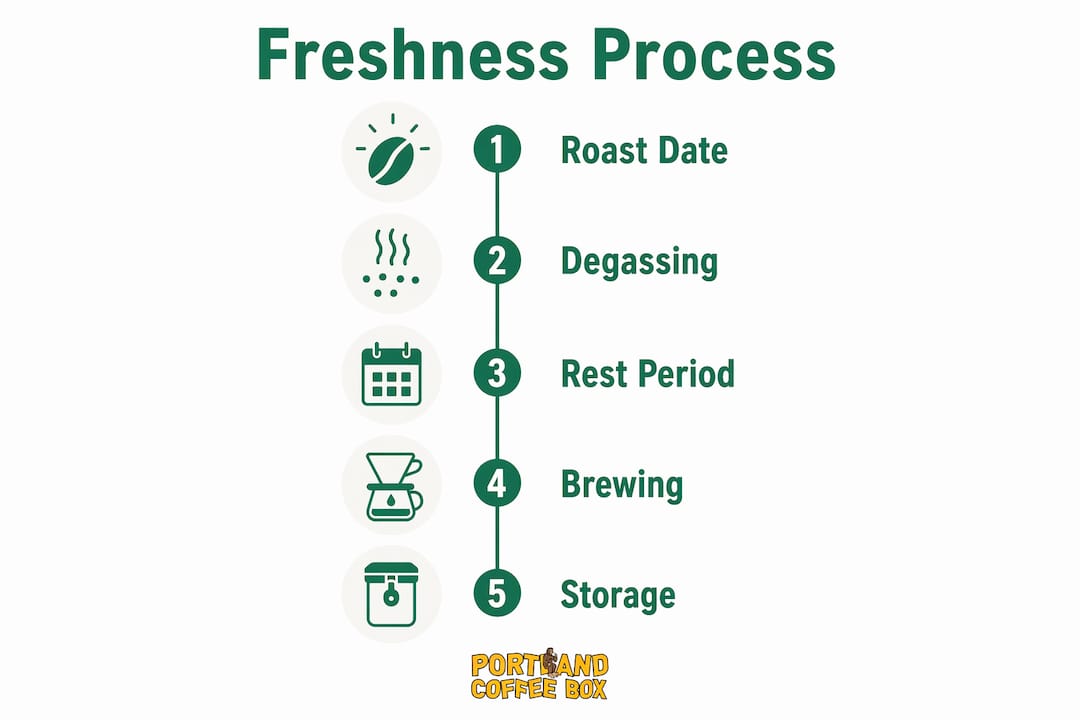
The roast date and the sell-by date are not the same thing. A sell-by date protects the retailer. A roast date protects your cup.
Freshly roasted coffee is best consumed within a flavor window that generally runs from 7 days to 6–8 weeks after roasting, depending on the blend and brew method. That range is wide because freshness is a spectrum, not a binary status. Here is how the window breaks down in practice:
| Brew Method | Ideal Rest Period | Maximum Freshness Window |
|---|---|---|
| Filter (pour over, drip) | 7–14 days | Up to 4–5 weeks |
| Espresso | 10–14 days | Up to 6–8 weeks |
| French press | 7–21 days | Up to 5 weeks |
| Cold brew | 14–21 days | Up to 8 weeks |
Most supermarket coffee is roasted weeks or months before it reaches the shelf. By the time you brew it, the flavor compounds that make specialty coffee worth drinking have largely degraded. Buying from roasters who print roast dates is the single most effective way to guarantee you are working with genuinely fresh coffee. Portland Coffee Box sources exclusively from Portland’s top craft roasters, all of whom provide full roast date transparency on every bag.
Storage is where most coffee enthusiasts lose flavor they paid for. Four environmental factors degrade freshness: oxygen, heat, light, and moisture.
One-way valve bags solve a specific problem. CO2 building up inside sealed bags after roasting reduces oxygen in the headspace to around 20% or less, slowing oxidation during shipping and storage. The one-way valve lets CO2 escape without letting oxygen in. This is why quality roasters use valve bags rather than standard sealed pouches.
Pro Tip: Store your beans in an airtight, opaque container at room temperature, away from heat and light. Only move to the freezer if you are storing a large quantity for more than a month, and freeze in single-use portions to avoid repeated thawing.
Timing your brew to the bean’s degassing phase is the difference between a good cup and a great one. Brewing too soon produces a sharp, astringent flavor. CO2 trapped in under-rested beans interferes with extraction, yielding a hollow mouthfeel and muted delicate flavor notes. Brewing too late means oxidation has already dulled the complexity you were waiting for.
Here is a practical timing framework:
Grind size also responds to roast age. Freshly rested beans are denser and require a slightly coarser grind. As beans age and CO2 continues to escape, they become more porous and extract faster. Adjusting your grind finer as the bag ages keeps your extraction consistent. For a deeper look at how small-batch roasting affects these timing windows, the roast method itself plays a significant role.
Freshly roasted coffee is a dynamic state defined by degassing, roast date transparency, and storage conditions, not a single moment of peak quality.
| Point | Details |
|---|---|
| Roast date over sell-by date | Always prioritize the roast date to time your brewing for peak flavor. |
| Degassing defines freshness | CO2 release in the first 24–48 hours signals an active, flavor-rich bean. |
| Brew method changes the window | Espresso needs 10–14 days of rest; filter coffee peaks at 7–14 days. |
| Storage protects your investment | Airtight, opaque, room-temperature storage preserves freshness longest. |
| Freshness is a spectrum | Coffee quality shifts gradually, so taste and adjust as the bag ages. |
by Cody Salane
The biggest misconception I see among coffee enthusiasts is treating freshness like a deadline. People obsess over buying beans the day they are roasted, then rush to brew them before some imaginary expiration. That approach actually produces worse coffee. Brewing too soon, before the CO2 has had time to settle, gives you a cup that tastes sharp and incomplete.
What I have learned from years of working with specialty roasters is that freshness is a conversation between the bean, the roaster’s choices, and your brewing method. A light Ethiopian natural processed through a slow roast will have a completely different degassing curve than a dark Sumatra. Treating them identically is like cooking two different proteins at the same temperature and time.
The enthusiasts who get the most out of fresh coffee are the ones who taste deliberately. They brew a cup at day 7, note the flavors, brew again at day 14, and compare. That practice builds intuition faster than any chart. It also makes the coffee more interesting, because you are tasting the development of a living product, not just consuming a commodity.
My practical advice: buy from roasters who print roast dates without hesitation. Any roaster confident in their product is proud to show you exactly when it was roasted. Opacity on that point is a red flag.
— Cody Salane
Portland Coffee Box was built around one belief: you deserve to know exactly when your coffee was roasted.
Every monthly box from Portland Coffee Box features small-batch beans handpicked from Portland’s top craft roasters, each bag printed with a clear roast date so you can time your brewing with confidence. Whether you prefer the brightness of a light roast filter or the depth of a rested espresso blend, the curated selection gives you the range to experiment with freshness windows firsthand. Subscriptions come in flexible sizes, ship free nationwide, and include roasters who share Portland Coffee Box’s commitment to quality and transparency. As a 1% For the Planet member, every box also supports environmental causes you can feel good about.
Freshly roasted coffee is coffee that has been recently roasted and labeled with a visible roast date, indicating it is in an active degassing phase where flavor compounds are at their most vibrant. The roast date tells you where the beans are in their flavor development window.
The optimal flavor window runs from 7 days to 6–8 weeks after roasting, depending on the brew method and roast level. Filter coffee peaks at 7–21 days, while espresso benefits from a longer rest of 10–14 days or more.
Freshly roasted beans contain high levels of CO2 that interfere with even extraction. Brewing too soon produces sharp, astringent flavors and a hollow mouthfeel. A rest period of at least 4–7 days allows CO2 to escape and flavor compounds to stabilize.
Store beans in an airtight, opaque container at room temperature, away from heat, light, and moisture. Reducing oxygen exposure is the single most effective way to extend freshness, which is why one-way valve bags are standard in specialty coffee packaging.
A roast date tells you exactly when the beans were roasted, giving you the information to time your brewing for peak flavor. A best-by date only tells you when the retailer considers the product acceptable to sell, with no reference to when roasting occurred.


