


-
Products
-
About Us
-
Roasters
- Gifts
Coffee cupping is defined as a standardized sensory evaluation method where freshly ground coffee is steeped in hot water and tasted as it cools, without any filtration or brewing equipment. The Specialty Coffee Association (SCA) developed a precise protocol for this process, making it the global benchmark for assessing coffee quality. Whether you’re a curious beginner or a seasoned enthusiast, understanding the coffee cupping process gives you a direct, unfiltered look at what’s actually in your cup. Portland Coffee Box curates coffees from Portland’s top craft roasters, and cupping is exactly how those roasters verify quality before a single bag ships.
The coffee cupping process follows a strict sequence of steps designed to remove guesswork and reveal a bean’s true character. Each step builds on the last, and skipping even one changes what you taste.
Weigh and grind your coffee. The SCA cupping protocol requires 8.25 grams of coffee per 150 milliliters of water. That ratio is not arbitrary. It creates a consistent extraction strength that let’s you compare any two coffees side by side without brewing bias.
Prepare five cups per sample. Professional cupping uses five cups per coffee to detect taints and confirm consistency across the batch. If one cup tastes different from the others, you’ve found a flaw in that sample.
Purge the grinder between samples. Run 2–3 grams of the next coffee through the grinder before grinding your actual sample. This clears residual grounds from the previous coffee and prevents flavor crossover.
Evaluate the dry aroma. Before adding water, lean in and smell the freshly ground coffee in each cup. The dry fragrance reveals volatile aromatic compounds that disappear once water is added.
Pour water at 93°C and start your timer. Water temperature matters. At 93°C, extraction is consistent and controlled. Pour directly over the grounds and let the crust form undisturbed.
Break the crust at 4 minutes. After four minutes, push through the floating crust with a spoon while leaning close to inhale the aroma. Breaking the crust releases a concentrated burst of aromatic compounds. This is the most aromatic moment in the entire process.
Skim the surface. Remove the remaining foam and grounds from the top of each cup using two spoons. This keeps the tasting surface clean.
Taste as the coffee cools. Tasting begins between 8 and 30 minutes after pouring, as the coffee cools from 75°C to 50°C. Flavors shift dramatically across this temperature range, so you taste multiple times rather than once.
Pro Tip: Rinse your tasting spoon in clean water between each cup. Flavor residue on the spoon is enough to skew your perception of the next sample.
The vigorous slurp technique is the defining tasting move in cupping. You draw coffee forcefully across your palate to atomize it, spreading flavor across every taste receptor at once. Gentle sipping misses the complexity that a proper slurp reveals.

Cupping strips away every variable that brewing introduces. No filter, no pressure, no agitation. What you taste is the bean itself.
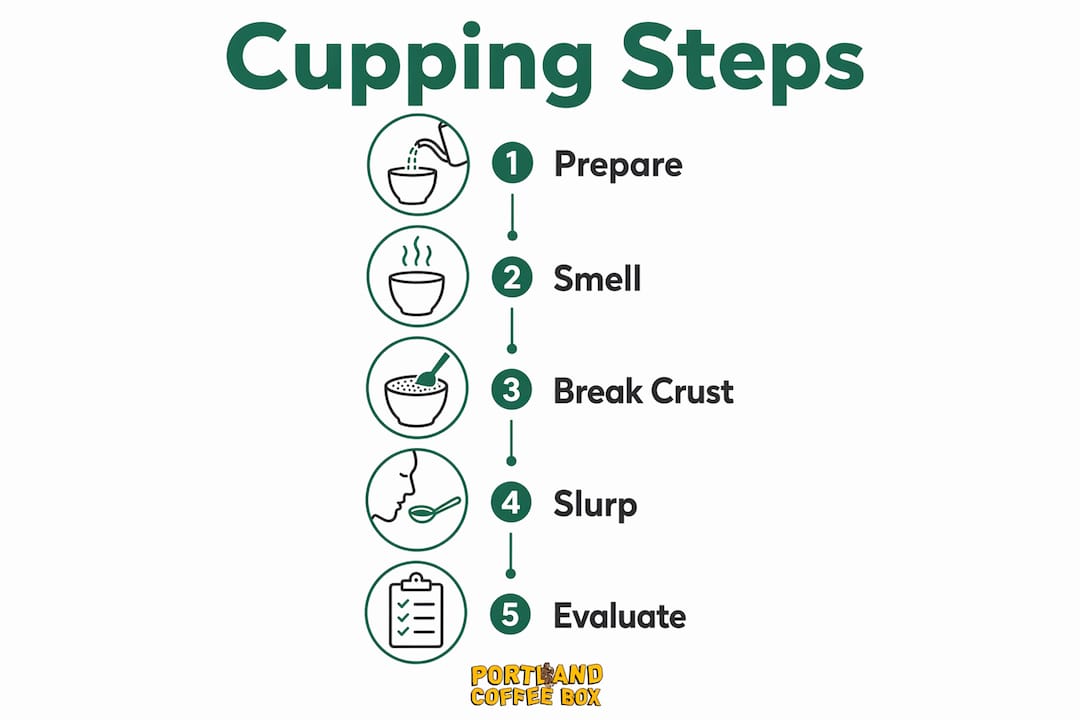
Cupping eliminates brewing variables to reveal a coffee’s inherent characteristics objectively. That objectivity is what makes it the universal standard across the global coffee trade. A roaster in Portland and a buyer in Tokyo can cup the same coffee under the same protocol and arrive at a shared understanding of its quality.
The benefits of cupping extend across every level of the coffee supply chain:
Coffee cupping is the most direct way to experience a bean’s terroir and roast profile without the noise of brewing variables. Terroir, the combination of soil, altitude, climate, and processing method, expresses itself most clearly in a cupped sample. Understanding coffee processing methods helps you predict what you’ll taste before you even grind the beans.
Most cupping errors come from inconsistency, not ignorance. The fix is almost always the same: slow down and standardize.
Pro Tip: Take notes in plain language, not scores. Write “tastes like dried cherry and dark chocolate” rather than “acidity: 7.” Descriptive notes build your palate faster than numbers do.
Sensory evaluation is also a skill that connects to broader culinary experiences. The same attention you bring to tasting food applies directly to cupping coffee. Treat it as a mindful practice, not a test.
Flavor in a cupped coffee is not static. It shifts continuously as temperature drops, and each stage reveals something different.
The window between 8 and 30 minutes post-pour is where the real evaluation happens. At higher temperatures, aroma dominates. As the coffee cools, acidity becomes more pronounced, sweetness emerges, and body becomes easier to assess. A coffee that smells floral at 75°C might taste bright and citrusy at 65°C and finish with a smooth, chocolatey sweetness at 50°C.
| Temperature | What you notice most | What to evaluate |
|---|---|---|
| 75°C (hot) | Aroma, fragrance intensity | Fragrance quality, initial body |
| 65°C (warm) | Acidity, brightness | Flavor clarity, fruit notes |
| 55°C (comfortable) | Sweetness, balance | Complexity, finish length |
| 50°C (cool) | Body, aftertaste | Mouthfeel, lingering flavors |
Flavors evolve significantly as coffee cools, which is why patience is the most underrated cupping skill. Tasting at only one temperature gives you a partial picture. Tasting across the full cooling range gives you the complete story of that coffee.
For beginners, the practical approach is simple. Taste each cup three times: once hot, once warm, and once cool. Write a few words after each pass. You’ll be surprised how much a coffee changes between your first and third taste. Understanding a coffee’s flavor profile before you cup it gives you a useful framework for what to look for as the temperature drops.
The purpose of cupping is to isolate the coffee’s pure properties by removing brewing variables such as filters and agitation. That isolation is what makes the flavor evolution so vivid. Nothing is masking it.
Coffee cupping is the most reliable way to evaluate a bean’s true character because it removes every brewing variable and lets flavor speak for itself.
| Point | Details |
|---|---|
| SCA ratio is non-negotiable | Use 8.25g of coffee per 150ml of water at 93°C for consistent, comparable results. |
| Five cups per sample | Cupping multiple cups of the same coffee detects taints and confirms batch consistency. |
| Break the crust at 4 minutes | This is the peak aromatic moment; inhale deeply as you push through the crust. |
| Taste across the cooling range | Evaluate each cup at 75°C, 65°C, and 50°C to capture the full flavor evolution. |
| Consistency beats equipment | Matching bowls and a clean spoon matter more than specialized cupping gear. |
I’ve sat at a lot of cupping tables over the years, and the thing that still surprises me is how much a coffee can change in twenty minutes. You taste it hot and think you know it. Then it cools, and suddenly there’s a sweetness you missed entirely, or an acidity that was hiding behind the heat.
Most beginners fixate on scoring. They want a number. But the score is the least interesting part of cupping. The interesting part is the moment you realize a coffee you thought was ordinary has a finish that lingers for a full minute. That’s the kind of discovery that changes how you shop for beans.
My honest advice: cup the same coffee three times over three weeks. You’ll learn more about your own palate from one repeated coffee than from tasting thirty different ones once each. Repetition builds vocabulary, and vocabulary is what lets you articulate why you love what you love.
Cupping also makes you a better buyer. Once you’ve cupped a range of origins and roast levels, you stop guessing and start knowing. You understand what a washed Ethiopian tastes like versus a natural Brazilian, and you can seek out exactly what you want. That knowledge is worth more than any subscription algorithm.
— Cody Salane
Cupping is most rewarding when you have genuinely different coffees to compare. A single origin from Ethiopia tastes nothing like a small-batch blend from a Portland roaster, and placing them side by side in a cupping session makes that contrast vivid and memorable.

Portland Coffee Box sources fresh, small-batch beans from Portland’s top craft roasters, curated for quality, variety, and seasonality. The three-bag subscription gives you three distinct coffees each month, which is the ideal number for a home cupping session. You get enough variety to compare origins and roast profiles without overwhelming your palate. Every box ships free, and you can adjust your roast preferences as your cupping palate develops. If you’re ready to taste the depth of Portland’s coffee culture, this is where to start.
The SCA cupping protocol is the global standard for evaluating coffee quality. It specifies 8.25 grams of coffee per 150 milliliters of water at 93°C, steeped for 4 minutes before breaking the crust.
Professional cupping uses five cups per coffee sample. Evaluating multiple cups detects taints and confirms consistency across the batch.
No special equipment is required. Matching bowls, a kitchen scale, a kettle with temperature control, and a spoon are enough to run a proper cupping session at home.
Tasting begins between 8 and 30 minutes after pouring, as the coffee cools from 75°C to 50°C. Evaluating across this range captures the full evolution of flavor and aroma.
Cupping removes all brewing variables by steeping grounds directly in water without filters or pressure. That isolation reveals the bean’s inherent qualities in a way that no brewing method can replicate.


 devel...&media=//portlandcoffeebox.com/cdn/shop/articles/1783239025438_Barista-smelling-fresh-coffee-grounds-in-cupping-bowl_600x.jpg?v=1783512865)