Menu
Portland Coffee Box
0
  • Products
    • Portland Coffee Box
    • Ratio Coffee
  • About Us
    • Our Story
    • 1% For the Planet
  • Roasters
    • Our Roasters
    • Roaster Application
  • Gifts
    • Corporate Gifting
  • Sign in
  • Your Cart is Empty
Portland Coffee Box
  • Products
    • Portland Coffee Box
    • Ratio Coffee
  • About Us
    • Our Story
    • 1% For the Planet
  • Roasters
    • Our Roasters
    • Roaster Application
  • Gifts
    • Corporate Gifting
  • 0 0

How to Brew in French Press: Café-Quality at Home

August 03, 2026

Use a standard ratio around 1:15, water near 93°C (200°F), a coarse grind, and about a 4-minute steep to produce a balanced, full-bodied French press coffee. That single sentence is the whole recipe. Everything else in this guide is about understanding why those numbers work and how to adjust them when your cup tells you something is off.

Quick-start recipe:

  • Ratio: 1 g coffee to 15 g water (1:15 is the canonical starting point)
  • Temperature: 93°C / 200°F (±3°C depending on roast)
  • Grind: Coarse, like coarse sea salt (690–1300 microns)
  • Steep: 4 minutes total, including a 30–45 second bloom
  • Beans: Fresh, small-batch specialty roasts from Portland Coffee Box
Press Size Water Coffee
~300 ml 300 ml 20 g
~500 ml 500 ml 33 g
~1 L 1,000 ml 67 g

Table of Contents

  • What gear do you actually need to brew consistently?
  • Step-by-step French press recipe with exact weights
  • How do you fix a sour, bitter, or muddy cup?
  • Which beans and grind profiles suit French press best?
  • How to clean your French press and grinder
  • Advanced techniques for a cleaner or more textured cup
  • What should you look for when buying a French press and grinder?
  • Key Takeaways
  • Why the French press rewards patience more than any other home method
  • Fresh beans from Portland Coffee Box make every recipe better
  • Useful sources and further reading

What gear do you actually need to brew consistently?

A French press is forgiving, but three tools separate a repeatable recipe from a daily guessing game.

  • Kitchen scale (gram-accurate): The Specialty Coffee Association identifies weight-based measurement as the single most reliable path to reproducibility. Bean density varies by roast and origin, so a tablespoon of light roast and a tablespoon of dark roast are not the same dose. A scale fixes that.
  • Burr grinder: Blade grinders chop unevenly, producing a mix of fine powder and large chunks that extract at different rates. A burr grinder produces consistent coarse particles in the 690–1300 micron range, which is what French press mesh is designed to handle.
  • Temperature-control kettle or thermometer: Boiling water (212°F) can scald delicate light roasts. A gooseneck kettle with a temperature dial makes hitting 93°C effortless.
  • Timer: A phone timer costs nothing and removes one more variable.
  • Quality French press: Look for a fine-mesh filter with a tight seal. Stainless steel frames outlast plastic; borosilicate glass beakers resist thermal shock better than standard glass.
  • Thermal carafe (optional but recommended): Decanting into a preheated server stops extraction the moment you pour.

Pro Tip: If you can only upgrade one thing, buy the burr grinder first. Grind consistency has a bigger impact on cup quality than any other single variable, including the press itself.
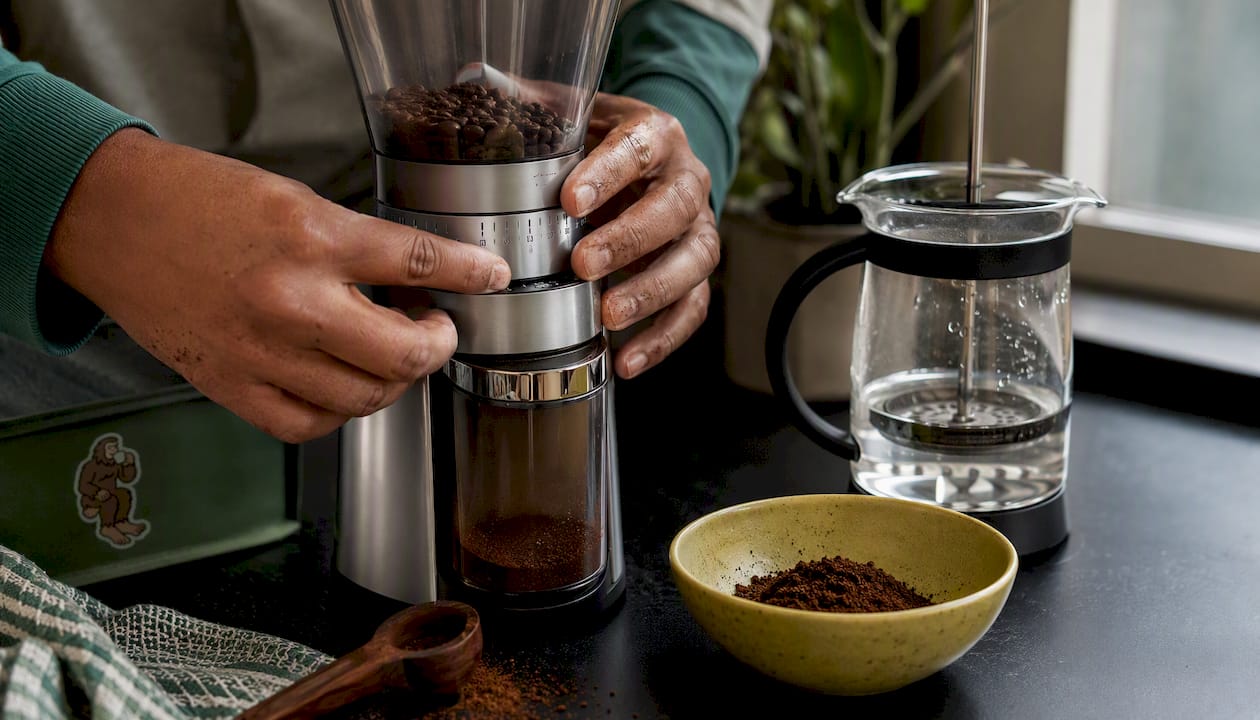

Hands adjusting burr grinder settings with fresh coffee grounds

Step-by-step French press recipe with exact weights

Prep (before you grind)

  1. Preheat the press by filling it with hot water, swirling, and discarding. This keeps your brew temperature stable from first pour to last sip.
  2. Weigh your coffee to the gram using the table above.
  3. Grind to a coarse, sea-salt texture. The particles should feel gritty, not powdery.

Brew

  1. Add grounds to the empty, preheated press.
  2. Bloom: Pour roughly twice the coffee weight in water (e.g., 40 g water for 20 g coffee) over the grounds. Start your timer. Wait 30–45 seconds. This releases CO₂ trapped in fresh beans and primes even extraction.
  3. Main pour: Pour the remaining water in a slow, steady spiral, finishing by 1:00 on the timer. Place the lid on with the plunger pulled up.
  4. Steep: Let the coffee sit undisturbed until 4:00.
  5. Plunge: Press the plunger down slowly and steadily over 20–30 seconds. Gentle, even pressure is the goal.
  6. Decant immediately into a preheated server or cups. Do not leave coffee sitting on the grounds.
Press Size Bloom Water Total Water Grind Steep
~300 ml 40 g 300 ml Coarse 4 min
~500 ml 60 g 500 ml Coarse 4 min
~1 L 120 g 1,000 ml Coarse 4 min

A gentle 20–30 second plunge and immediate decant are the two highest-impact technique points across every specialty French press guide.

How do you fix a sour, bitter, or muddy cup?

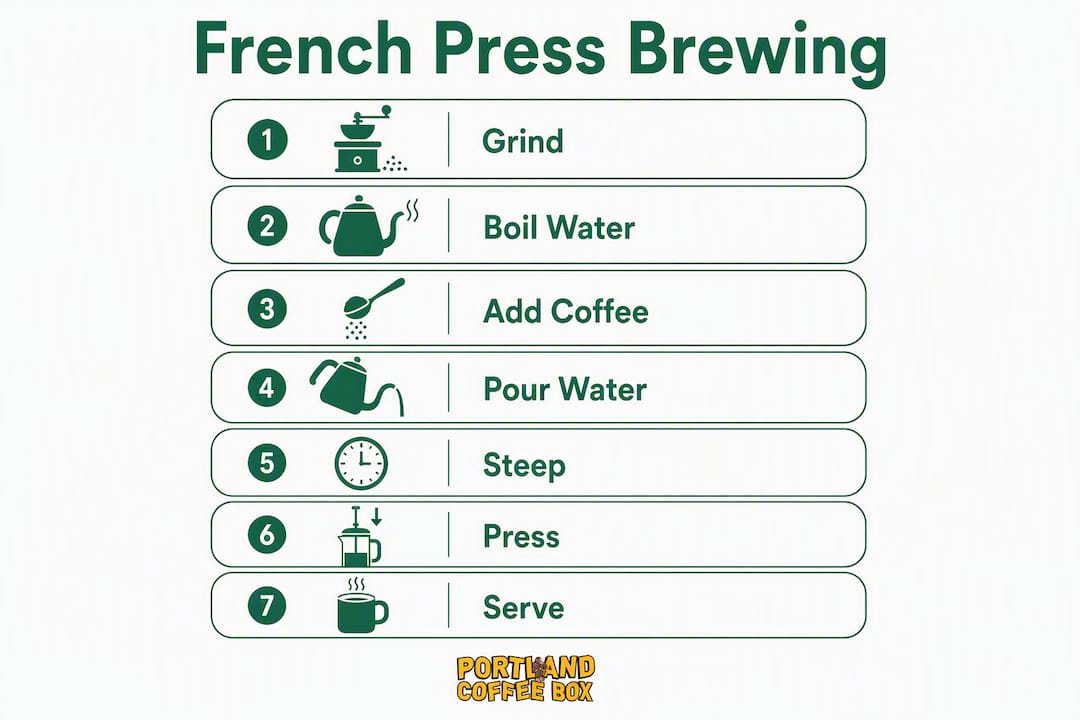
Infographic showing French press brewing steps

Most French press problems trace back to one of two root causes: under-extraction (sour, thin, sharp) or over-extraction (bitter, harsh, flat). CoffeeGearHub’s 2026 brew guide maps the fix clearly.

Sour or under-extracted:

  • Grind slightly finer
  • Raise water temperature toward 95°C
  • Extend steep to 4:30 or 5:00
  • Increase ratio toward 1:13

Bitter or over-extracted:

  • Coarsen the grind
  • Drop temperature to 90–91°C
  • Shorten steep to 3:30
  • Loosen ratio toward 1:16–1:18

Muddy or gritty:

  • Coarsen the grind (fines pass through the mesh)
  • Let the brew sit 30 seconds after pressing before pouring, so fines settle
  • Try a paper filter laid under the metal mesh before plunging (see Section 7)
  • Decant immediately and completely

Pro Tip: Change one variable at a time. If you adjust grind, temperature, and steep simultaneously, you will not know which fix worked. Start with grind; it moves the needle most.

“Grind changes are usually the most effective single move for French press troubleshooting.” — CoffeeGearHub French Press Brew Guide

Plunger resistance as a diagnostic: Steady, gentle resistance over 20–30 seconds means your grind is correct. Sudden, hard resistance means the grind is too fine or grounds have clumped. If the plunger drops with almost no resistance, the grind is too coarse.


Which beans and grind profiles suit French press best?

Roast level changes how your recipe should be calibrated. Lighter roasts benefit from a slightly higher ratio and longer extraction; darker roasts release flavor faster and can turn bitter if pushed too hard.

Roast Level Starting Ratio Temperature Notes
Light 1:16 93°C Longer steep preserves floral/fruit notes
Medium 1:15 93°C Balanced baseline; most forgiving
Dark 1:13 90–91°C Shorter steep; watch for bitterness

Whole-bean freshness matters more in French press than in almost any other brew method because the full-immersion process amplifies both the best and worst qualities of the bean. Aim to use beans within 2–4 weeks of the roast date. Stale beans produce flat, papery cups that no ratio adjustment can fix.

Pro Tip: Use Portland Coffee Box’s monthly subscription to rotate through light, medium, and dark roasts. Each new bag is a controlled experiment: same recipe, different roast, and you will hear exactly what the ratio and temperature adjustments are doing.


How to clean your French press and grinder

Skipping maintenance is the most common reason a dialed-in recipe starts tasting off. Coffee oils go rancid within days and coat the mesh, the beaker walls, and the grinder burrs.

Daily rinse (French press)

  1. Discard grounds into a compost bin (not the drain).
  2. Rinse the beaker and plunger assembly with hot water.
  3. Dry with a clean cloth or air dry upside down.

Weekly deep clean (French press)

  1. Disassemble the plunger fully: unscrew the mesh stack and separate the screens.
  2. Soak all metal parts in warm, soapy water for 10 minutes.
  3. Scrub the mesh gently with a soft brush. Avoid abrasive pads on glass beakers.
  4. Rinse thoroughly and reassemble only when dry.

Grinder maintenance

  • Weekly: Brush out the burr chamber with the grinder’s cleaning brush.
  • Monthly: Run grinder-cleaning tablets (like Grindz) through the burrs to remove oil buildup.
  • Annually: Inspect burrs for wear; replace when grind consistency drops noticeably.
Task Frequency Why it matters
Rinse press Daily Prevents rancid oil buildup
Deep clean mesh Weekly Keeps filtration consistent
Brush grinder burrs Weekly Removes stale grounds
Clean burrs with tablets Monthly Removes oil residue
Replace burrs Annually Restores grind consistency

Replace cracked glass beakers immediately. A hairline crack can fail under thermal stress.


Advanced techniques for a cleaner or more textured cup

Once the baseline recipe is solid, these three approaches let you push toward specialty-level clarity or experiment with texture.

Extended immersion with settling

Use a medium-coarse grind, extend total steep to 6–8 minutes, and do not stir after pouring. Allow fines to settle to the bottom before pressing very gently. James Hoffmann’s approach favors this method for reducing suspended sediment while keeping body intact.

  1. Grind medium-coarse (slightly finer than standard).
  2. Pour all water at once; skip the bloom.
  3. Place lid on, plunger up. Wait 6–8 minutes.
  4. Press extremely slowly over 45–60 seconds.
  5. Decant immediately.

Paper-filter hybrid

Lay a rinsed paper filter (cut to fit or use a standard cone filter folded flat) beneath the metal mesh before plunging. This removes oils and fines that pass through the screen, producing a noticeably cleaner, tea-like cup. The trade-off is reduced body. Specialty brewers seeking clarity favor it; those who love French press’s signature richness usually skip it.

Crust-break vs. no-stir

Breaking the crust (the floating grounds layer) at 4 minutes and skimming the foam before pressing produces a slightly cleaner result. Skipping the stir entirely and pressing through the crust is faster and preserves more body. Neither is wrong; they produce different cups from the same recipe.

Pro Tip: Try the paper-filter hybrid with a light roast from Portland Coffee Box’s micro-lot selection. The clarity it produces lets delicate floral and fruit notes come through in a way the standard metal mesh can obscure.


What should you look for when buying a French press and grinder?

French press features

  • Beaker material: Borosilicate glass is heat-resistant and shows the brew clearly. Double-wall stainless steel keeps coffee hotter longer and is nearly unbreakable.
  • Mesh quality: A fine, multi-layer mesh reduces sediment. Check that replacement mesh kits are available for the model you buy.
  • Lid and seal: A tight-fitting lid with a smooth plunger rod reduces wobble during pressing.
  • Capacity: Match press size to your typical brew volume. Brewing less than half the press capacity produces uneven extraction.

Grinder features

  • Burr type: Flat burrs and conical burrs both work well at home. Conical burrs are quieter and retain fewer grounds between uses.
  • Coarse-setting range: Confirm the grinder reaches a true coarse setting. Some entry-level burr grinders top out at medium-coarse, which is too fine for French press.
  • Easy cleaning: Removable upper burrs make weekly brushing practical.

Buying checklist

  1. Must-have: Burr grinder with true coarse range, gram-accurate scale, borosilicate or stainless press
  2. Nice-to-have: Temperature-control kettle, thermal carafe, replacement mesh kit
  3. Avoid: Blade grinders, presses with plastic mesh, presses without spare-parts availability

Portland Coffee Box carries a curated selection of brewing accessories that pair directly with French press brewing, so you can pick up gear and beans in one place.


Key Takeaways

A reproducible French press recipe requires a 1:15 ratio, 93°C water, a coarse grind in the 690–1300 micron range, and a 4-minute steep followed by immediate decanting.

Point Details
Start with 1:15 ratio Use 20 g coffee per 300 ml water; adjust between 1:13 and 1:16 by roast.
Water temperature matters 93°C (200°F) is the specialty baseline; go cooler for dark roasts, slightly hotter for light.
Grind coarse and consistent Target 690–1300 microns (coarse sea salt); a burr grinder is non-negotiable.
Decant immediately Leaving coffee on grounds continues extraction and causes bitterness within minutes.
Portland Coffee Box Fresh small-batch beans from Portland’s top roasters reduce dialing-in time and improve cup consistency.

Why the French press rewards patience more than any other home method

Most home brewers treat the French press as the easy option, the one you use when you do not want to think. That framing undersells it. The French press is actually the most honest brewer in your kitchen. It hides nothing. Stale beans, an inconsistent grind, water that is too hot or too cool — every variable shows up in the cup with unusual clarity. That is not a flaw; it is the method telling you exactly what to fix.

The specialty coffee community has spent years refining what works: weight-based measurement, coarse and consistent grinds, controlled temperatures, and immediate decanting. These are not fussy habits. They are the difference between a cup that tastes like what the roaster intended and one that tastes like a vague approximation of it.

Portland Coffee Box was built around the belief that great coffee at home starts with great beans and the knowledge to use them. The brewing guides, roaster partnerships, and fresh small-batch subscriptions aim to provide home brewers raw materials and methods similar to those used by specialty cafés. Portland Coffee Box is also a proud 1% For the Planet member, donating a portion of every order to environmental causes, because the coffee community and the planet it depends on are inseparable.

If you are serious about your French press, measure everything, change one variable at a time, and use beans fresh enough to bloom properly. The rest follows naturally.


Fresh beans from Portland Coffee Box make every recipe better

Portland Coffee Box

The fastest way to shorten your dial-in time is to start with beans that are actually fresh. Portland Coffee Box ships small-batch specialty roasts from Portland’s top craft roasters directly to your door, nationwide, with free shipping on every order.

Choose the subscription that fits your brewing habit:

  • One Bag Coffee Box: One fresh bag per month. Perfect for beginners who want to try a single roast before committing to more.
  • Two Bag Coffee Box: Two bags per shipment, ideal for regular French press brewers who want variety without overflow.
  • Three Bag Coffee Box: A mid-size option for steady at-home drinkers who love rotating through seasonal picks.
  • Four Bag Coffee Box: Four roasts per month for enthusiasts who want to dial in multiple profiles side by side.
  • Two Bag Micro Lot Box: Rare, small-batch micro-lot selections for specialty brewers who want to push their recipe experiments further.

Browse all options and start your subscription at Portland Coffee Box.


Useful sources and further reading

The research and guidance behind this guide draws from these authoritative sources:

  • French Press Brew Guide: Ratio, Grind, Temp & Steps — CoffeeGearHub: Canonical ratio guidance (1:15), troubleshooting patterns, and step-by-step technique.
  • James Hoffmann (YouTube channel): Temperature recommendations, extended-immersion method, plunger resistance diagnostics, and decanting rationale.
  • Specialty Coffee Association (SCA): Weight-based measurement standards and specialty extraction principles.
  • The French Press Techniques Pros Swear By — Food & Wine: Paper-filter hybrid technique and barista-level clarity methods.

“The French press is definitely a potential coffee happily-ever-after, but as with all things coffee, it ain’t rocket science… but it is science.” — Serious Eats, Coffee Science: How to Make the Best French Press Coffee at Home

For practical follow-ups, Portland Coffee Box’s brewing blog covers how to track brew variables at home and brewing consistently between busy days.

Recommended

  • Small Batch Coffee Brewing Tips for Specialty Lovers - Portland Coffee Box
  • Brew Consistent Coffee Between Meetings: A Pro Guide - Portland Coffee Box
  • How to Track Coffee Brew Variables at Home - Portland Coffee Box
  • Craft Coffee Tasting for Beginners: Quick Checklist - Portland Coffee Box
  • Share:

Leave a comment


Also in The Coffee Guide

Pouring chocolate syrup into espresso at kitchen counter
What Is a Coffee Mocha? Ingredients, Origin, and Recipe

August 07, 2026

Discover what is coffee mocha, its key ingredients, origin, and an easy recipe to brew this delicious chocolate espresso drink at home.

Read More

Hands packing coffee bag into subscription box
Support Environmental Causes with Purchases: A Practical Guide

August 06, 2026

Discover six impactful ways to support environmental causes with purchases. Make a difference with every dollar you spend today!

Read More

Woman ordering groceries online at home kitchen
Why Home Delivery Beats Store Runs for Busy Shoppers

August 05, 2026

Discover why home delivery beats store runs for busy shoppers. Save time, avoid impulse buys, and enjoy convenience today!

Read More

Follow

contact@portlandcoffeebox.com

  • About
  • Contact
  • FAQ's

Sign up to get the latest on sales, new releases and more…

contact@portlandcoffeebox.com

© 2026 Portland Coffee Box.
Powered by Shopify

American Express Apple Pay Diners Club Discover Google Pay Mastercard PayPal Shop Pay Visa